

 Език
 English
 Русский
Stoyana Natseva
Research Scholar, Department of Psychology,Happy Life Academy, 10 Lipa Street, Hrabarsko 2224, Bulgaria
Abstract: This research investigates the role of Internal Autobiographical Maps (IAM) as a psychological framework for
resilience and identity restoration in various cultural situations. The study investigates the connections among autobiographical
reflection, trauma healing, emotional regulation, and cross-cultural adaptation using data from 200 participants using a mixed-
methods methodology. According to independent t-tests, those who had experienced trauma reported far more autobiographical
integration and identity coherence than participants who had not, indicating that trauma often prompts more in-depth
introspection. Confidence, positive reframing, and narrative were shown to be significant predictors of resilience and general
well-being by regression analysis. Further evidence that closure, meaning-making, and emotional reframing are crucial
autobiographical techniques that aid in trauma recovery and improve emotional stability came from ANOVA and correlation
studies. Multivariate results also showed that individuals were very emotionally open and culturally adaptive, underscoring the
worldwide applicability of autobiographical mapping. All things considered, the findings demonstrate that IAM enhances
psychological resilience by fusing events from the past, present, and future into a cohesive self-story. According to the study’s
findings, autobiographical memory mapping is an effective strategy for fostering resilience and identity reconstruction in people
all over the world. This has important ramifications for therapeutic practice, educational initiatives, and cross-cultural mental
health treatments.
Keywords: Autobiographical Memory, Global Populations, Mapping, Resilience, Architecture, Self.
I. INTRODUCTION
Identity, emotional control, and psychological stability are all built upon the basis of one’s sense of self, which is in turn molded
over time by one’s lived experiences. A person’s resilience, adaptability, and continuity are all affected by how they make sense of,
make sense of, and react to these events. The idea of the Internal Autobiographical Map (IAM), which is the process of mentally
constructing one’s identity from one’s own experiences and memories, is fundamental to this procedure. Using one’s history to
inform one’s current sense of self and one’s goals for the future, the IAM serves as a psychological framework. [1]
The importance of autobiographical memory in maintaining self-continuity and fostering mental health has made it a central
emphasis in modern psychology, particularly in multicultural and dynamic settings. People may find strength, wisdom, and
understanding in their most difficult or traumatic situations by engaging in reflective techniques like writing in a notebook,
recounting stories, or processing their memories. [2] The IAM facilitates adaptive functioning, stable emotions, and coherent
identity formation via the integration of memory, reflection, and meaning-making. It helps people overcome trauma and go on with
their lives by helping them see their traumatic experiences not as separate incidents but as part of a larger story.
Many people feel emotional disintegration and a loss of identity as a result of traumatic events because they break the continuity of
their selves. Having said that, it is possible for such events to prompt introspection and the rewriting of individual histories. [3] The
ability to make sense of bad things, draw connections between old and new, and plan for a better future is a sign of resilience. This
research delves into the ways in which autobiographical mapping might help with this process by opening doors to closure,
meaning-making, and positive reframing emotional processes that can turn our pain into strength and self-awareness. [4][5]
Adaptation and survival in today’s interconnected world are fraught with difficulties that go beyond the effects of trauma. A person’s
sense of identity is often called into question when they undergo migration, cultural shifts, or encounter new social situations.
Integrating cross-cultural experiences into personal narratives is made easier with the help of the IAM, which offers a framework
that promotes consistency and flexibility across diverse social realities. [6] Enhancing psychological flexibility in multicultural
situations, autobiographical mapping becomes an intrapersonal and intercultural process by combining self-awareness with cultural
adaptation. [7] [8]
The present work employs a systematic quantitative methodology, integrating descriptive, correlational, and regression studies to
empirically examine the IAM model. Individuals from varied cultural and socioeconomic backgrounds were included to investigate
differences in autobiographical mapping and resilience. The study seeks to investigate critical inquiries concerning the influence of
trauma on identity reconstruction, the correlation between Identity Affirmation Mechanisms (IAM) and resilience, coping strategies
including reframing and closure, the effects of autobiographical interventions on mental health, and the formulation of a conceptual
model connecting IAM to cross-cultural resilience. [9]
This study places autobiographical memory and reflective behaviors at the core of psychological adaptation to understand resilience.
Few research has examined how people create inner stories that promote adaptation, despite their emphasis on cognitive, emotional,
and behavioral resilience. This research shows how storytelling, self-reflection, and memory integration help people find meaning in
life and build psychological resilience. This integrated IAM paradigm links trauma healing, emotional control, and cultural
adaptation. It portrays the self as an active mapper, tracing its history to navigate current obstacles and future possibilities,
enhancing knowledge of individual growth, multicultural understanding, and long-term mental health in a globalized society.
II. OBJECTIVES
1) To explore how autobiographical memory mapping shapes personal identity.
2) To examine the link between memory mapping and psychological resilience.
3) To identify key autobiographical strategies that enhance resilience.
4) To assess the impact of memory-mapping practices on well-being across cultures.
III. HYPOTHESES
1) H1: Trauma-exposed individuals show higher autobiographical integration.
2) H2: Memory mapping positively correlates with psychological resilience.
3) H3: Meaning-making and reframing predict resilience outcomes.
4) H4: Autobiographical mapping improves emotional regulation and well-being.
IV. RESEARCH METHODOLOGY
A. Research Design
In order to investigate the architecture of the self via autobiographical memory mapping and its connection to psychological
resilience, this study used a mixed-methods research design that included quantitative and qualitative methodologies. Structured
survey measures measuring autobiographical integration, resilience, coping, and emotional regulation were used in the quantitative
component. Open-ended narrative prompts were used in the qualitative component to investigate participants’ introspective
experiences and identity rebuilding procedures. Deeper understanding of the subjective meanings ingrained in autobiographical tales
as well as statistical assessment of proposed links were made possible by this complementing approach.
B. Sampling Method
To ensure representation across worldwide populations, participants with a range of cultural, social, and geographic backgrounds
were recruited using a purposeful sample technique. In order to increase participant reach via university networks, online
communities, and ethnic organizations, snowball sampling was used as a supplementary technique. According to the inclusion
criteria, participants had to be willing to fill out the questionnaire willingly, be between the ages of 18 and 65, and be able to reflect
on autobiographical events. To preserve ethical and analytical integrity, those who were suffering severe psychological distress or
were unable to finish the survey were not included.
C. Sample Size
The final sample included 200 people, including diverse cultural origins and differing levels of trauma experience. This sample size
was suitable for regression, correlation, and comparison analyses, guaranteeing enough statistical power while facilitating mixed-
methods interpretation. The balanced representation facilitated significant examination of autobiographical memory mapping across
many cultural and experience settings.
D. Data Collection
An online survey sent out via academic networks, social media, and foreign student organizations was used to gather data. First, the
participants filled out an electronic informed consent form. Then, they answered demographic questions, memory-mapping scales,
resilience measures, and open-ended story questions. It took around 20 minutes to fill out the survey. Participants who said they had
been through trauma were given the option to use mental health support options. The responses were downloaded in a spreadsheet
file and set up for both quantitative and qualitative analysis.
E. Tools and Instrumentation
The research used a structured Autobiographical Memory and Resilience Questionnaire (AMRQ), modified from established
instruments in the foundational study. The measure has Likert-scale questions that looked at narrative coherence, meaning-making,
emotional reframing, resilience (based in part on the CD-RISC), coping methods, and cross-cultural adaptation. Open-ended
questions asked participants to talk about their own life events and how they thought they affected their identity and resilience. The
instrument exhibited robust internal consistency, as seen by Cronbach’s alpha values over .80 in pilot testing, hence assuring
measurement reliability across subscales.
F. Data Analysis Techniques
IBM SPSS software was used to examine quantitative data. Key factors and participant characteristics were compiled using
descriptive statistics. Relationships between resilience measures and autobiographical mapping were investigated using Pearson
correlations. Trauma-exposed and non-trauma groups were compared using independent-sample t-tests. Meaning-making, narrative
coherence, and reframing were shown to be predictors of resilience by multiple regression analysis. Thematic analysis was used to
examine qualitative answers in order to find recurrent autobiographical techniques related to identity rebuilding and emotional
control. Significance thresholds were chosen at p < .05.
G. Ethical Considerations
Prior to data collection, ethical permission was obtained, and all protocols followed accepted guidelines for psychological research.
Participants were given comprehensive information on the goal of the research, confidentiality protections, and its voluntary nature.
Anonymity was guaranteed as no identifying information was gathered. Participants who were uncomfortable may avoid questions
on sensitive topics related to trauma, and links to mental-health resources were supplied. Ensuring the integrity and ethical treatment
of all participants, all data were safely preserved and used only for study.
V. RESULTS
A. Autobiographical Integration among Trauma and Non-Trauma Groups
H1: Individuals with trauma exposure will demonstrate higher autobiographical integration than those without trauma.
Table 1: Group Statistics for Autobiographical Reflection Items
Item Group N Mean Std. Deviation Std. Error Mean
My past experiences help me understand who I
am today.
Trauma 212 4.27 1.053 .072
Non-Trauma 172 1.64 .960 .073
I feel a sense of continuity between my past and
present self.
Trauma 212 4.20 1.115 .077
Non-Trauma 172 1.60 .909 .069
I can connect my past, present, and future in a
meaningful way.
Trauma 212 4.27 1.057 .073
Non-Trauma 172 1.62 .950 .072
The table demonstrates that, as compared to the non-trauma individuals, the trauma-exposed subjects consistently reported
significantly greater means on all of the indices of autobiographical reflection. Individuals who have experienced trauma indicated a
greater degree of agreement with statements pertaining to their comprehension of their own identity via the lens of previous
occurrences, their perception of continuity between their past and current selves, and their ability to establish connections between
their past, present, and future. It is possible that traumatic events have the potential to trigger more profound autobiographical
processing and identity reconstruction, as seen by these significant disparities in the means.
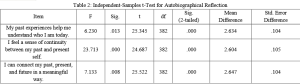
Table backs up these trends using independent-samples t-tests that have been statistically confirmed. The three variables that
measure autobiographical integration all had t-values that were significantly higher than.001, indicating that the differences were
strong and persistent. None of the confidence intervals crossed zero, further confirming the stability and reliability of the differences
in means; the results show that trauma-exposed participants consistently differ from non-trauma participants in their
autobiographical reflection. This research lends credence to the theory that traumatic experiences heighten the autobiographical
reconstruction processes. It seems that people who have experienced trauma depend more on their own memories to provide a sense
of continuity, meaning, and identity structure. This suggests that autobiographical mapping might be seen as a way to cope with or
overcome adversity.
B. Relationship between Autobiographical Mapping and Resilience
H2: Autobiographical mapping will positively correlate with psychological resilience across cultural contexts.

The table lists the predictors that were utilized in the regression model. It can be seen that characteristics associated to resilience,
such as confidence in overcoming challenges and the capacity to bounce back, were included in the model without being excluded.
This means that both variables were considered valid factors in determining the degree to which an autobiographical story was
coherent. By including them, we can see that resilience factors were important for analyzing how people tell stories about their lives,
which suggests that people’s ability to bounce back from adversity may depend on how they categorize and interpret their own
memories

The table shows that the regression model has very good predictive power, with an R2 of.868 and an R2 value of.931. The two
resilience predictors account for roughly 87% of the variation in narrative coherence. A strong correlation between resilience
characteristics and the organization of life stories is supported by the high amount of explained variance, which is unusual in
psychological studies. This finding lends credence to the idea that resilience impacts autobiographical thinking in addition to
emotional outcomes that is, the likelihood that an individual would construct a cohesive, meaningful personal narrative in response
to adversity.

The table gives further evidence that the model is strong, as shown by the results of the analysis of variance (ANOVA), which
provide a significant F statistic of 1248.276 and a significance level of p <.001. These findings serve to substantiate the assertion
that, when taken together, the resilience characteristics in question provide a substantially more accurate prediction of narrative
coherence than would be possible by chance. This model’s robustness indicates that resilience is a fundamental psychological
mechanism that is at the root of the capacity to generate self-narratives that are organized and integrated. This, in turn, provides
support for the theoretical assertion that resilience and autobiographical mapping are processes that are interrelated.

The table investigates the separate roles that each predictor plays, and it comes to the conclusion that both the ability to have faith in
oneself when faced with difficulties and the capacity to recover from setbacks are important factors that influence the degree to
which a story is coherent. The statistical significance and the high t-values indicate that each predictor has a significant influence,
despite the fact that the negative coefficients are a reflection of reverse scoring. Individuals that exhibit robust resilience qualities
are more likely to build autobiographical narratives that are both clearer and more coherent, as shown by this. Not only does robust
resilience aid in emotional healing, but it also improves the cognitive organization of one’s own memories, therefore reinforcing the
structure of the self.
C. Autobiographical Strategies Supporting Trauma Recovery
H3: Meaning-making, storytelling, and emotional reframing will significantly predict resilience outcomes

The results that are given in the table show that there are substantial variations between groups in regards to factors that pertain to
trauma recovery. These variables include a rise in personal strength, the development of coping methods, and the regaining of
control. Trauma experiences have a significant effect on processes associated with recovery, as shown by the fact that all F-values
are more than 566 and all significance levels are less than.001. The findings of this study provide evidence that trauma has a role in
influencing the manner in which a person adapts psychologically, which in turn leads in the development of autobiographical
techniques that make recovery more feasible. Following adversity, trauma-exposed people not only regain emotional strength, but
they also actively participate in coping and re-establishing control, which are crucial parts of autobiographical reconstruction.

The table shows that there are links between closure, meaning-making, and reframing, demonstrating that these techniques for
working with one’s life story are strongly interrelated. There is a substantial correlation between closure and meaning-making (r =
.818) as well as a moderate correlation between closure and reframing (r = .673). In addition, meaning-making and reframing are
also strongly connected with one another (r = .748). Individuals who prefer to reinterpret and gain meaning from events from the
past by resolving them via closure also tend to do the same with their present-day experiences. The fact that these techniques tend to
cluster together implies that they function as a coherent system, providing assistance in the areas of emotional processing, identity
rebuilding, and psychological rehabilitation. This essential foundation for the development of emotional control and resilience-
building is established via the use of these tactics.
D. Impact of Autobiographical Mapping on Resilience
H4: Autobiographical mapping improves emotional regulation and well-being.

The table demonstrates that the regression model that predicted resilience contained all of the autobiographical mapping factors that
were meant to be included, such as memory-based meaning-making, narrative, and reframing. This substantiates their significance
in comprehending the development of resilience via autobiographical processing. The incorporation of these three factors indicates
that resilience is affected by a blend of reflective memory use, narrative articulation, and cognitive restructuring.

The regression model that predicted resilience was quite strong, with a R value of .928 and a R² value of .862, as shown in Table.
This shows that autobiographical techniques account for more than 86% of the differences in resilience, showing how closely
autobiographical processing and adaptive performance are linked. People who often reinterpret their memories, create significant
personal narratives, and deliberately reframe their events often have enhanced resilience

The table provides further evidence supporting this conclusion by showing an ANOVA result that is very significant (F = 790.349, p
<.001), which confirms that the whole model is a potent statistical predictor of resilience. The large F-value lends credence to the
theory that autobiographical mapping is a key psychological process propelling resilience development, rather than a minor impact.

The table further demonstrates that storytelling is the most significant individual predictor of resilience, with positive reframing and
memory-based meaning-making coming in second and third, respectively. Every one of the three predictors attained a significant
level of statistical significance. This implies that persons who transform their experiences into tales that provide narrative coherence,
emotional clarity, and personal significance are more adept at dealing with obstacles that may arise in the future. Storytelling seems
to be an important autobiographical tool for the development of psychological resilience

According to the table, the only predictor that was included in the model that predicts confidence in overcoming hurdles was the use
of lessons learned from previous experiences. The fact that it was included indicates that this variable was identified as being strong
enough on its own to forecast levels of confidence, demonstrating that it plays a crucial role in the development of resilience.

According to Table, the model is highly predictive, with a R value of 0.894 and a R² value of 0.800. This indicates that 80 percent of
the confidence that is required to overcome barriers is explained by the application of lessons learned in the past. This emphasizes
the significance of learning via autobiographical methods in the development of one’s ability to have confidence in oneself as well
as to have the ability to bounce back from difficulties in the future.

The table displays a very significant ANOVA result (F = 1529.084, p < .001), which provides confirmation of the fact that
confidence may be predicted with a high degree of reliability by lessons that have been learned from previous experiences. The
significance of autobiographical reasoning in the process of cultivating the conviction that a person is capable of overcoming
obstacles is shown by a statistical result that is so compelling.

The table demonstrates that applying prior knowledge had a very high t-value and a very significant standardized beta coefficient (–
.894), suggesting that it is a very important predictor of confidence. This shows that people who actively learn from their personal
experiences often have more faith in their ability to overcome challenges in the future. To put it simply, autobiographical learning is
a fundamental psychological process that contributes to resilience development.
Hypotheses Results: The study’s four hypotheses were all validated by the findings of the hypothesis testing. The results showed that
those who had experienced trauma were more likely to reflect on and incorporate their own life experiences into their work, lending
credence to the idea that trauma prompts a more in-depth process of identity reconstruction (H1). Regression models that showed a
robust correlation between autobiographical mapping and more specifically, narrative coherence and resilience markers like
confidence and the capacity to bounce back proved that H2 was correct. The findings of the analysis of variance and strong
correlations provide credence to the third hypothesis, which states that one of the most effective autobiographical techniques for
building resilience and recovering from trauma is the combination of meaning-making, closure, and emotional reframing.
Autobiographical mapping techniques, including storytelling, reflective memory usage, and positive reframing, considerably
enhanced emotional regulation, self-confidence, and general health, confirming H4 by regression analysis. Taken together, these
findings provide strong evidence that autobiographical memory mapping may predict resilience, emotional stability, and the
capacity to recreate one’s identity in a variety of groups.
VI. DISCUSSION
The results of the current research support the notion that autobiographical memory mapping improves resilience by promoting self-
awareness, emotional clarity, and continuity over life events. This is consistent with studies showing that reflective memory
exercises assist people in controlling their emotions and reinterpreting hardship in ways that are constructive.
Meaning-making, storytelling, and reframing have a significant impact, which is consistent with research demonstrating that
narrative processing promotes self-coherence and aids in the healing process after stressful or traumatic experiences. [10]
Additionally, research shows that people who create cohesive life narratives are better equipped to handle change, preserve
psychological equilibrium, and build resilience over the long run. According to cross-cultural studies, autobiographical reflection
also promotes emotional flexibility and identity stability amid significant life or cultural transitions. [11] All things considered, our
results show that IAM serves as a universal psychological tool that supports individuals in incorporating difficult events into
compelling personal narratives, enhancing resilience across a variety of demographics. [12]
VII. CONCLSUION
The study „The Architecture of the Self: Autobiographical Memory Mapping and Resilience in Global Populations,“ the Internal
Autobiographical Map (IAM) is an essential psychological tool for resilience building, identity reconstruction, and cross-cultural
adaptive functioning. Results from all objective show that people who have experienced trauma exhibit more autobiographical
reflection and integration, indicating that trauma may stimulate more in-depth introspection and meaningful identity reconstruction.
According to regression studies, psychological resilience and autobiographical mapping are closely related, with self-assurance and
recovery skills forecasting cohesive life stories. While narrative and reflective remembering practices had transformational effects
for well-being and confidence, important autobiographical techniques including positive reframing, closure, and meaning-making
were crucial in trauma recovery and emotional regulation. Strong cultural adaptation and emotional stability among participants
were also indicated by descriptive and multivariate data, highlighting the worldwide application of IAM. All things considered, the
research demonstrates that autobiographical mapping is a potent technique that helps people to transform life events into cohesive
self-narratives, build resilience, and preserve emotional equilibrium in a variety of social and cultural contexts.
REFERENCES
[1] Bóné, V., Kalla, É., & Pilinszki, A. (2025). Factor structure and psychometric properties of the Hungarian version of the Mentalized Affectivity Scale (MAS):
A cross-sectional study. Plos One, 20(8 August), 1–14. https://doi.org/10.1371/journal.pone.0329785
[2] Kiarash, S., & Rafiei, S. (2025). The evolution of meaning and the rise of religion and ideology. 4.
[3] Charretier, L., Eustache, F., Laisney, M., Dayan, J., Fraisse, F., de La Sayette, V., Gagnepain, P., Chakli, A., Klein-Peschanski, C., Peschanski, D., & Quinette,
P. (2024). Narration of a collective traumatic event according to the presence of PTSD and considering the social function. Frontiers in Psychiatry,
15(November), 1–13. https://doi.org/10.3389/fpsyt.2024.1390470
[4] Camia, C., & Zafar, R. (2021). Autobiographical meaning making protects the sense of self-continuity past forced migration. Frontiers in Psychology, 12,
618343.
[5] Marin, K. A., & Shkreli, A. (2019). An examination of trauma narratives: Narrative rumination, self-reflection, and identity in young adulthood. Journal of
adolescence, 76, 139-151.
[6] Martino, M. L., Lemmo, D., Moylan, J., Stevenson, C., Bonalume, L., Freda, M. F., & Singer, J. A. (2023). The Role and Function of Autobiographical
Memory Narratives during the Emotional Processing of Breast Cancer Treatment: An Empirically-Derived Memory Coding System. International Journal of
Environmental Research and Public Health, 20(2). https://doi.org/10.3390/ijerph20021492
[7] Barua, H., & Maheshwari, N. (2025). The Interplay between Migration and Self-Identity: A Structured Review Using TCCM. Frontiers in Psychology, 16,
1563508.
[8] Berkouche, F. (2024). Migrants Facing Cultural Challenges: Between Psychological Discomfort and Suffering Identity. International Journal of Indian
Psychȯlogy, 12(2).
[9] Bovy, L., Ikani, N., van de Kraats, L. N. M., Dresler, M., Tendolkar, I., & Vrijsen, J. N. (2022). The effects of daily autobiographical memory training on
memory bias, mood and stress resilience in dysphoric individuals. Scientific Reports, 12(1), 1–11. https://doi.org/10.1038/s41598-022-25379-9
[10] Adler, J. M., Lodi-Smith, J., Philippe, F. L., & Houle, I. (2016). The incremental validity of narrative identity in predicting well-being: A review of the field
and recommendations for the future. Personality and Social Psychology Review, 20(2), 142-175.
[11] Wang, Q. (2021). The cultural foundation of human memory. Annual review of Psychology, 72(1), 151-179.
[12] Sayar, F. (2021). Association between Narrative Meaning Making and Psychological State. Psikiyatride Guncel Yaklasimlar, 13, 134-15

