
 Language
 Български
 Русский
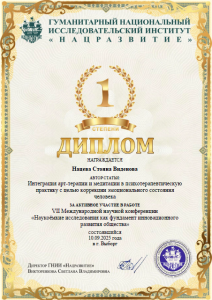
On September 21, 2025, Dr. Stoyana Natseva, founder of Happy Life Academy and author of 15 bestsellers, was awarded a First-Degree Diploma at the prestigious VII International Scientific Conference “Scientific Research as the Foundation for Innovative Development of Society” held in Vyborg, Russia.
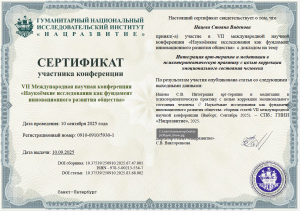
Her scientific article, entitled “Integration of Art Therapy and Meditation into Psychotherapeutic Practice for the Correction of the Emotional State of the Individual,” received high recognition from the international jury and was included in the official conference proceedings with ISBN 978-5-00213-554-7 and DOI: 10.37539/250910.2025.83.68.002. This distinction places Bulgaria among the leading countries in advancing modern approaches to emotional and mental health.
“For me, this distinction is not just an award, but confirmation that science and practice go hand in hand. I believe that through research and education we can create a new generation of leaders who will transform the world through faith, hope, and love,” shared Dr. Natseva.
With over 100,000 students trained worldwide, 9 internationally accredited MBA programs, the innovative DBA program “Leaders of the Future” and the global mission of “1 Million Awakened Leaders,” Dr. Stoyana Natseva continues to build bridges between science, spirituality, and business. Her work in systemic psychology, neuropsychology, coaching, and ancestral therapy has already inspired millions of followers in Bulgaria and around the world.
This international recognition represents another step toward positioning Happy Life Academy as a global leader in education and personal development.
The article is published in the official proceedings of the VII International Scientific Conference “Scientific Research as the Foundation for Innovative Development of Society” (Vyborg, 2025), with ISBN 978-5-00213-554-7 and individual DOI: 10.37539/250910.2025.83.68.002, ensuring its international indexing and accessibility.
Integration of Art Therapy and Meditation into Psychotherapeutic Practice for the Correction of the Emotional State of the Individual
Abstract. This article is devoted to the analysis of a modern approach in psychological practice—art therapy and meditation. It explores theoretical foundations, historical roots, and scientific studies confirming the effectiveness of these methods in reducing anxiety, depression, and stress, as well as in developing emotional and cognitive resilience. Particular attention is given to the role of creativity and mindful practices in harmonizing psycho-emotional states, to the neuropsychological mechanisms underlying their effects, and to their integration into clinical and rehabilitative practice. The article also presents leading theorists and researchers who contributed to the development of art therapy and meditation, as well as Russian counterparts and prospects for further research.
Keywords: art therapy, meditation, psycho-emotional health, neuropsychology, stress, anxiety, emotional regulation, psychological harmonization, creativity.
Art Therapy
Art therapy is a psychological method that employs creative activity (drawing, modeling, music, dance, etc.) to express and explore an individual’s inner world, with the aim of improving their psycho-emotional state. The approach is based on the assumption that the process of creativity fosters self-expression, stress reduction, and the development of mindfulness. Art therapy is characterized by nonverbal expression of emotions, which helps overcome language barriers and facilitates contact with deep-seated feelings.
Scientific studies show that art therapy reduces anxiety, depression, and stress, improves mood, and promotes the formation of a positive self-concept. In neuropsychology, these effects are linked to the activation of the right hemisphere of the brain (responsible for intuition and emotions) and a decrease in cortisol, the stress hormone.
Notable contributions to the development of art therapy were made by Carl Gustav Jung with his theory of the collective unconscious and archetypes. Margaret Naumburg is considered one of the founders of art therapy as a discipline, while Vija Lusebrink, Shaun McNiff, Cathy Malchiodi, Andrew Grants, and other scholars and practitioners have advanced and studied the method’s effectiveness.
In Russia, art therapy has been actively developed since the late 20th – early 21st century, with research and practical contributions from specialists such as V. A. Kotulskaya, N. F. Ignatenko, S. V. Mikhailova, A. S. Anisimov, among others.
Today, art therapy is widely used in psychotherapy, rehabilitation after trauma, in work with children, and in support groups. It is effective both independently and in combination with other psychological methods.
Meditation
Meditation is applied either as an independent method or in combination with cognitive-behavioral therapy, body-oriented techniques, and art therapy. Widely used practices include mindfulness, breathing techniques, and visualizations.
Meditation is a psychological practice aimed at achieving inner calm, concentration, and mindfulness, which leads to the harmonization of the psycho-emotional state. It activates the parasympathetic nervous system, reduces cortisol levels, and decreases anxiety and depression.
Among the leading researchers are Jon Kabat-Zinn (creator of the MBSR program—Mindfulness-Based Stress Reduction), Richard Davidson, as well as a number of Russian scholars (Petrenko, Kucherenko, Filatova, Lemeshevskaya, Urbanaeva, and others) who view meditation as both a practice of personal development and a scientifically grounded method of psycho-emotional regulation.
Integration of Art Therapy and Meditation
The integration of art therapy and meditation broadens the toolkit for self-regulation, supports the safe expression of suppressed negative emotions, reduces emotional tension, and develops skills for mobilizing inner resources. Over time, these skills become automated, leading to positive changes in personality traits, psychological resilience, and the harmonization of emotional states.
References
-
Williams, J. M. G., & Kabat-Zinn, J. (2011). Mindfulness: Diverse perspectives on its meaning, origins, and multiple applications at the intersection of science and dharma. Contemporary Buddhism, 22, 1–18.
-
Filatova, A. F. (2015). Meditation and personal development. Vestnik OGPU, 2(6), 70–74.
-
Ricard, M. (2012). The Art of Meditation: Inspirational Exercises and Examples. Moscow: Eksmo.
-
Goleman, D., & Davidson, R. (2018). Altered Traits: How Meditation Changes Your Mind, Brain, and Body. (Trans. Yu. Gimatova). Moscow: Mann, Ivanov & Ferber.
-
Petrenko, V. (2013). Meditation as a psychological practice of working with the Spirit. Personality Development, 4, 117–130.
-
Lemeshevskaya, M. N. (2015). Meditation as a psycho-acmeological practice of self-development of personality. Acmeology.
